Products / Fortunate®
AI for Connecting
 Moments
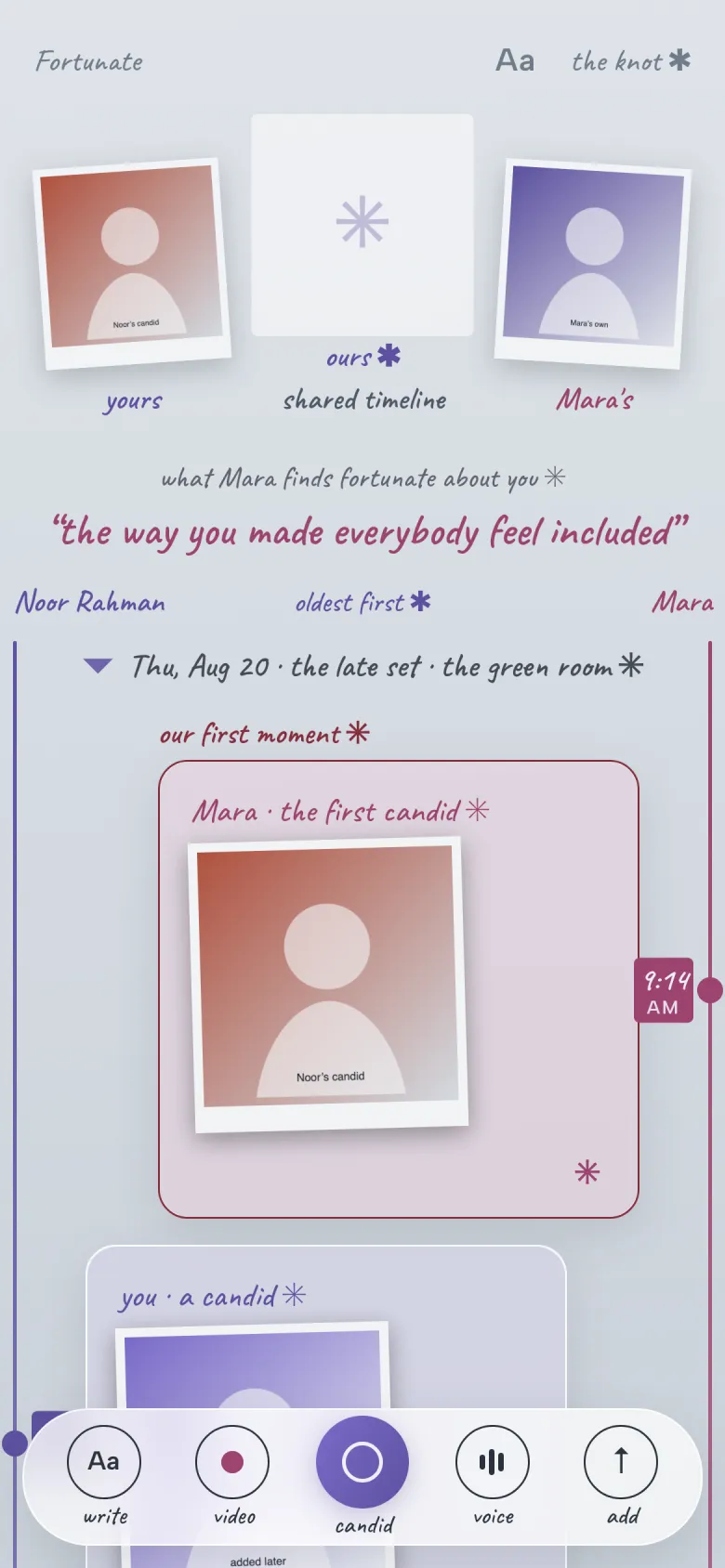
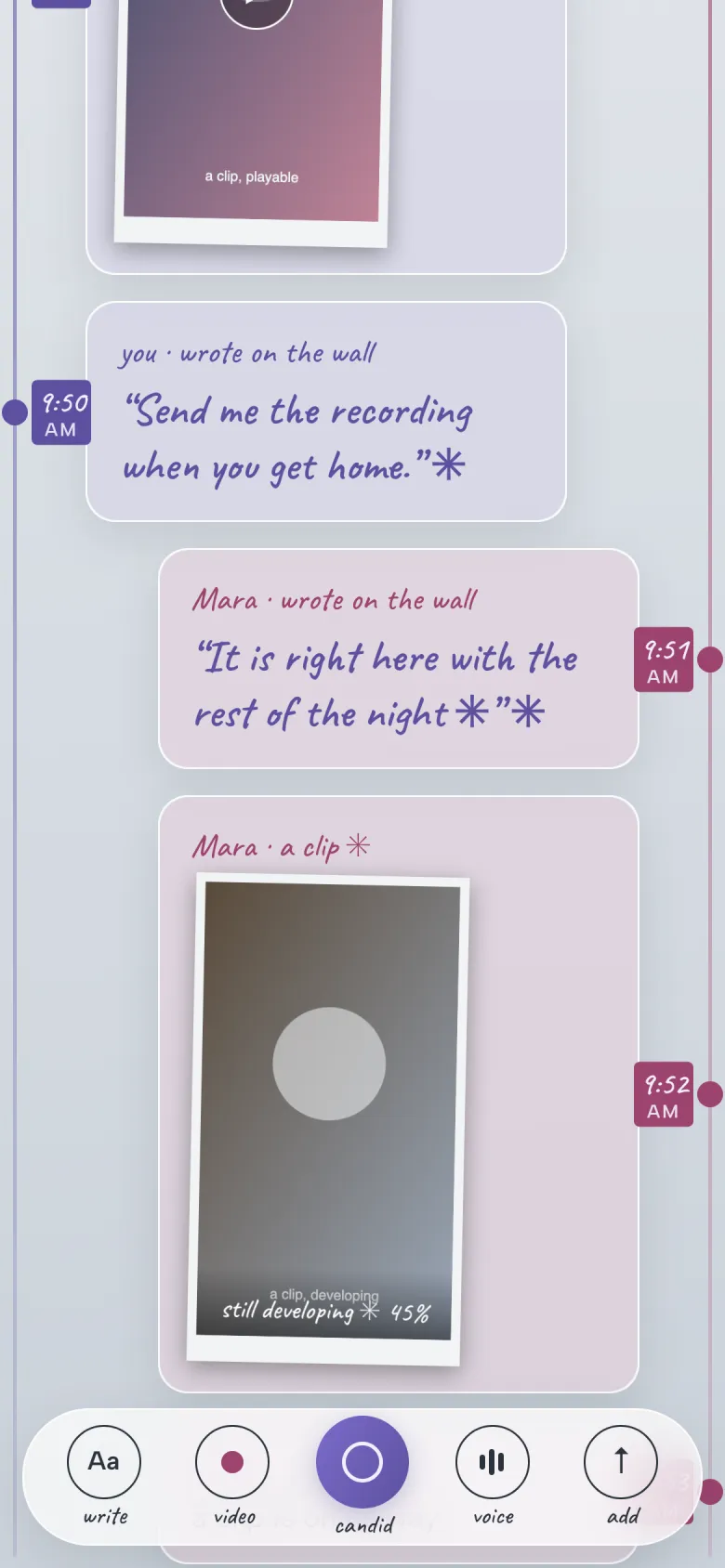
A notebook on your phone for the people you meet. It remembers who, when, where and the moment you met, and sends them a note of that moment from your own phone.
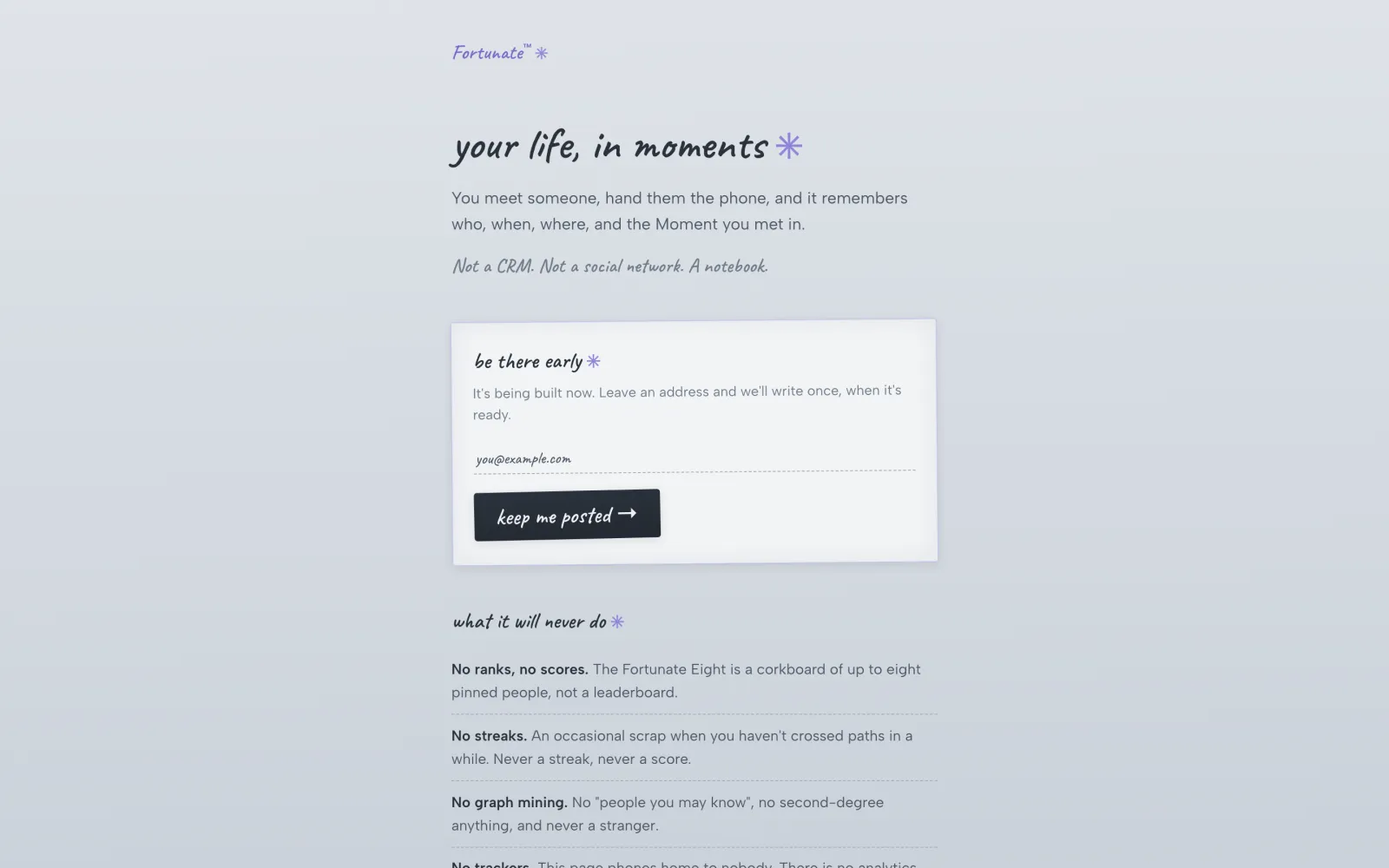
“Not a CRM. Not a social network. A notebook.”
Problem and solution
A name with no context. A photo with no name.
The problem
You meet someone worth knowing at a gig or a dinner, and a week later you have a name with no context, or a photo with no name.
Existing tools either manage people, like a CRM, or broadcast to them, like a social network. Neither is how remembering someone feels.
What Fortunate® does
It keeps each person as the moment you met (who, when, where) in a notebook that lives on your phone, and lets you send them that moment as a note.
Every feature has to pass one test: “Does it feel like remembering, or like managing?” It is for people who meet people in person and want to keep them. Today, that means invited beta testers.
Capabilities
Built and in the beta.
Capture in the moment
The other person takes the photo and fills in their own card, behind a lock that keeps the rest of your phone closed. Or pick them from your contacts.
BetaA note from your own phone
Fortunate writes a text in your Messages with a link. They open it in any browser for 30 days, with no app or account, and you both add words, photos, voice and clips.
Note pages liveA private line
Your updates reach only people you already have a note with. No followers, no counts.
BetaOne account, every device
A note belongs to your account and can be sent again from any of your devices.
Beta“Say it”
Speak a memo and it fills in the person’s card as suggestions you check. Ask a spoken question and your phone searches your notebook.
In the lab · testers opt inWhat the AI actually does
Words go up. Never the notebook, never the sound.
Fortunate® uses AI in two narrow places: turning words you say into suggested lines for a card, and turning a question into a search filter. Both are built and live, in the lab, for testers who switch them on.
A spoken memo fills the card
- After the other person hands your phone back, you say a memo: “guitarist from Boulder, plays a little keyboard.”
- Speech becomes text on the phone, using your people’s names as spelling hints. A phone that can’t do this on the device gets a text box instead.
- Only the memo’s words and today’s date go to a language model, which returns suggested lines for the card’s existing fields.
- You check them; nothing is saved until you tap “keep it”. The line the other person will see must use words you actually said.
A question searches your notebook
- You say or type something like “a guy I met in October who plays guitar from Boulder.”
- The model returns a filter, not an answer: when, places, what about, names, and who they know.
- Your phone runs that filter on its own notebook and explains each match from the parts that matched, never from the model’s text.
- If nothing matches, it falls back to a plain text search.
How it is kept in bounds
- One relay, one key, on the server. The key never reaches a phone, a web page or a log.
- Zero data retention is requested on every call, and logs record the route and timing, never the words.
- Signed requests from signed-in phones, with per-phone and service-wide daily limits.
- Chosen by measurement. A bake-off of about 440 requests on fictional memos picked one Claude model for cards, because it repaired transcription errors best, and a smaller one for search.
Not AI
- Capture, contacts and the note itself, including its link and the text from your own Messages.
- The shared timeline and personal updates.
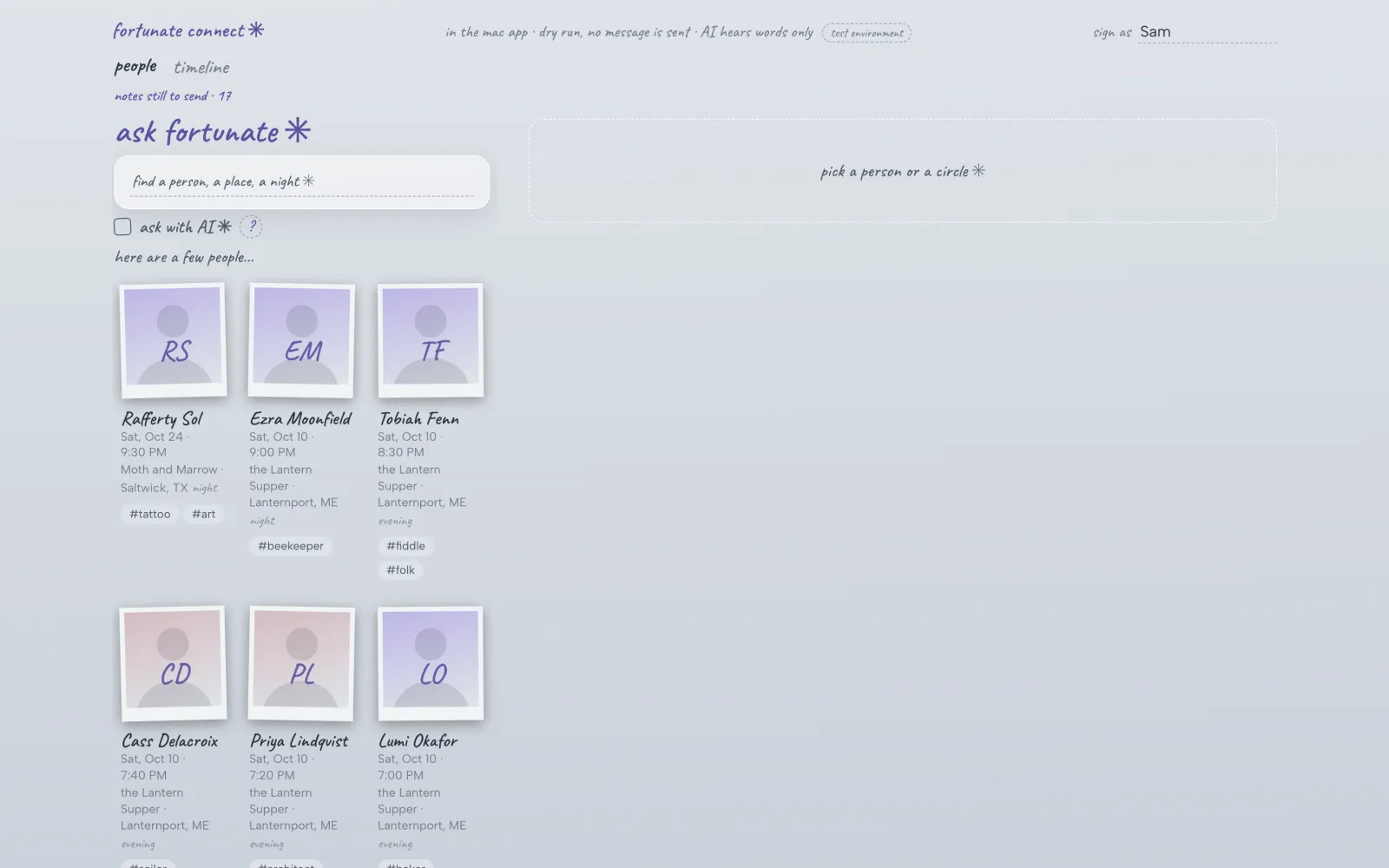
- Plain search on the phone, and in the Mac companion unless you choose “ask with AI”.
- The “together” photo in invitations is a collage: no AI, and no face sent to anyone.
- No ranks, scores, streaks or “people you may know”: a written rule, stated on the public front page.
The product, as it is
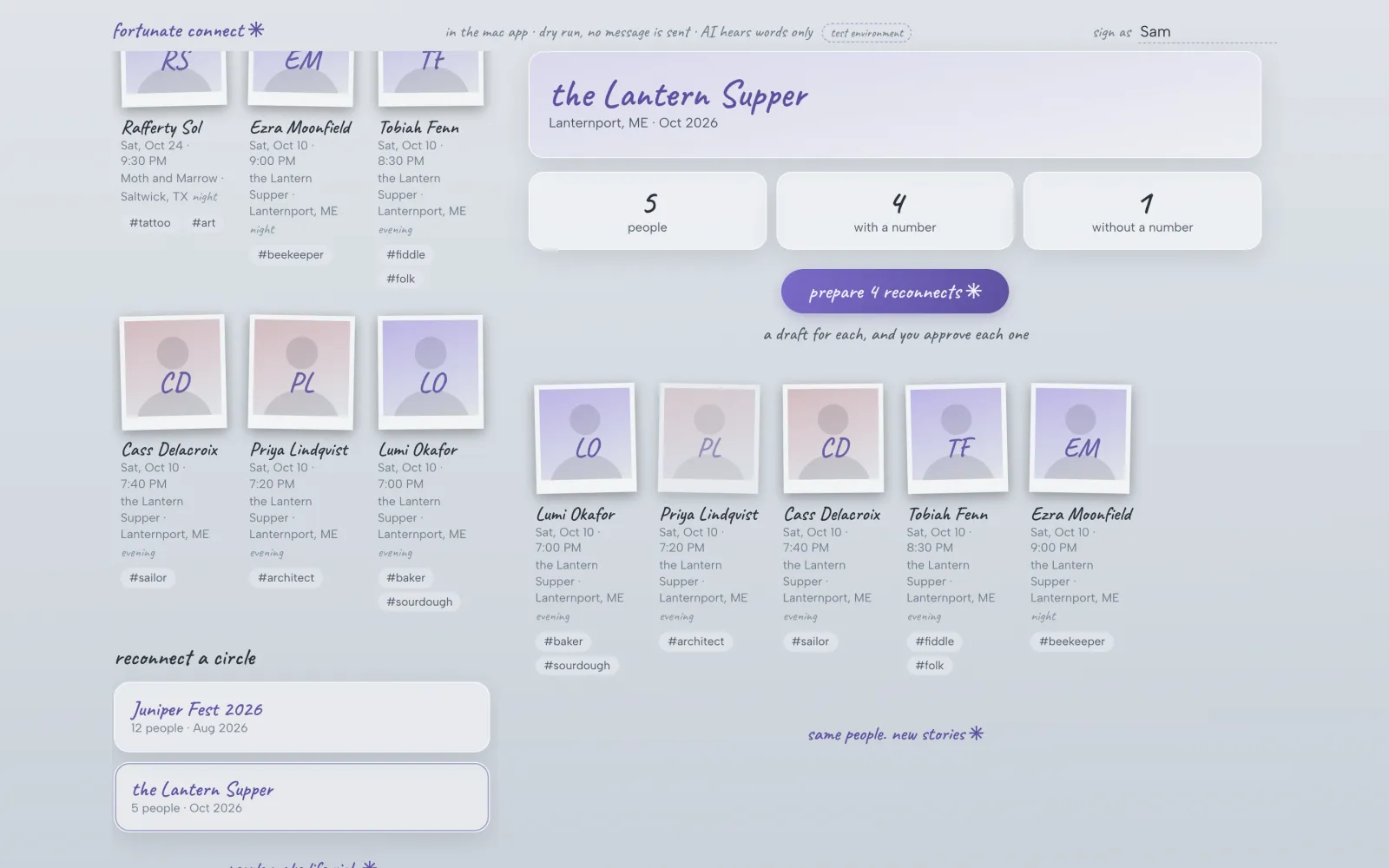
Real screens, invented people.
Every screenshot was taken from the real interface on a local machine, with the network blocked and invented test people. There is deliberately no screenshot of the AI: it needs a signed-in production account, and we won’t stage a result.
Stage and business
A closed beta, built carefully.
Fortunate® is pre-revenue. No price is set and nothing is charged.
- DirectionAn optional way to pay for more video and messages, as a tier or add-ons. Its form and price are not decided.
- How it spreadsEvery note opens in the recipient’s browser, so each new person first meets Fortunate® through someone they just met.
- EngineeringAbout 12,700 automated tests, 38 architecture decision records, and independent code audits in November 2026.
| Part | Stage |
|---|---|
| iPhone app | Closed beta On TestFlight for internal and invited testers; a new build reached them on 17 Nov 2026. Not on the App Store. No Android build yet. |
| Web note pages and API | Live In production. |
| “Say it” memo and voice search | In the lab Built and live; each tester turns it on. |
| Fortunate Connect for Mac | In development A working prototype; not released. |
| Pricing | Not set Nothing is charged. |
It’s being built now.
Leave an address at fortunate.now and the team will write once, when it’s ready.
Facts on this page were checked against the product’s code and decision records on 17–20 November 2026.